


Stakeholder Alignment Is Not
a Phase. It's a Practice.
Author
Philipp Eiselt
Topic
Transformation
Change Management
Published
November 2025
Read time
9 min
I have seen more transformation programs stall mid-way than fail at launch. The failure modes at launch are visible and get addressed. The failures that happen at month seven or month twelve are quieter: a sponsor who has mentally moved on, a business unit that has stopped engaging, a steering committee that no longer has the energy to make hard calls. These are all stakeholder alignment failures. And they are almost all predictable.
The kickoff alignment illusion.
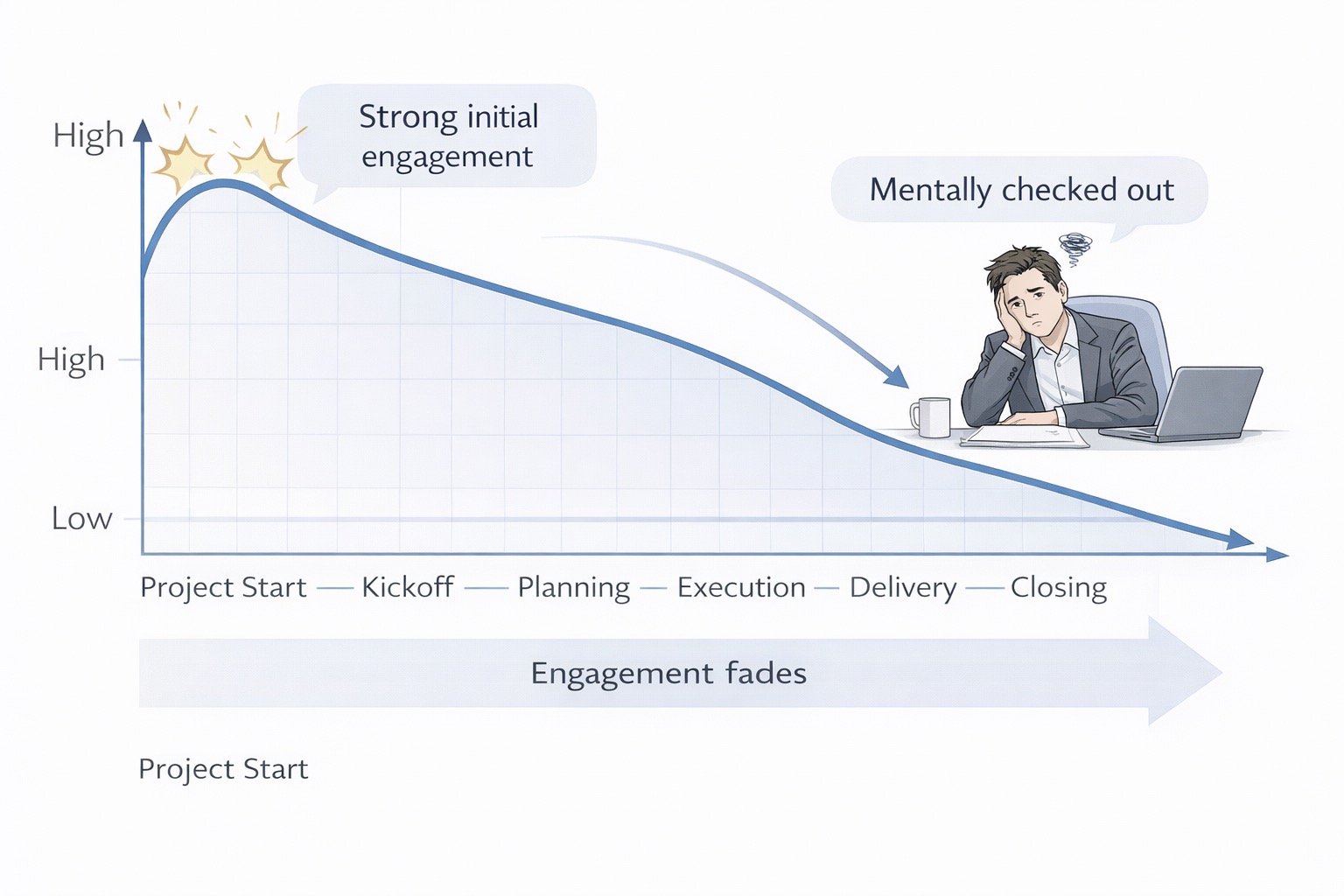
Most transformation programs invest heavily in stakeholder alignment at the beginning. There are workshops, steering sign-offs, communications plans, change impact assessments. The theory is that if you get everyone on board at the start, the program can execute against a stable mandate. The theory is wrong.
Alignment at kickoff captures a snapshot of stakeholder sentiment at a specific moment, in a specific organisational context. That context changes. Business priorities shift. Senior sponsors move on or have their attention captured by other crises. Teams that were enthusiastic in the workshop find out what the change actually means for their day-to-day work and become resistant. The competitor landscape changes. Budget cycles create new pressures. Any of these can erode the alignment you built at the start, and none of them require a catastrophic event to do it. Drift is gradual and, precisely because it is gradual, it often goes undetected until it has become a serious problem.
Why alignment decays.
Alignment decays on running programs for three consistent reasons. The first is information asymmetry. Stakeholders who are not close to the program gradually form their own picture of how it is going, based on corridor conversations, rumours, partial updates from team members, and their own inference from visible signals. If the program is not proactively filling that information gap with accurate, honest updates, the gap will be filled with whatever happens to be available.
The second is expectation drift. The original business case described an outcome. As the program delivers, that outcome gets reinterpreted by different stakeholders in light of their current context. What sounded like a useful capability in the boardroom presentation two years ago may not feel relevant to a business unit that has reorganised twice since then. If the program is not actively re-validating that the promised outcome is still the right one, and adjusting scope or communication if it is not, it will arrive at delivery with a product that the organisation no longer quite needs.
The third is sponsor fatigue. Long programs consume a lot of leadership energy. Sponsors who were active and engaged in year one are often exhausted or distracted by year two. This is a human reality, not a failure of character. The program's job is to design for it. Make it easy for sponsors to stay engaged with a small, consistent time commitment, rather than requiring them to repeatedly re-invest effort to catch up.
A continuous alignment model.
What works is a lightweight, regular rhythm. Not a heavy re-alignment process, but a small number of consistent touchpoints that keep stakeholders informed and give the program early warning of emerging issues. In practice, this looks like three things.
A brief, regular sponsor update. Not a status report. A short, direct communication from the program lead to key sponsors covering what was decided since the last touchpoint, what decision is coming that requires their input, and what has changed in the risk or dependency picture that affects them. It should take sponsors ten minutes to read and require action no more than monthly. If it requires action more often than that, the program is escalating too much upward. Fix the decision rights instead.
A business change forum. A regular session, usually monthly, with the operational leads who will own the outcome after delivery. This is where expectation drift gets caught early. If a business unit is forming a view that the program is not delivering what they need, this is the forum where that surfaces in time to address it, not at acceptance testing when it is too late to change anything meaningful.
A pre-decision stakeholder view. Before any significant decision that will affect stakeholders, a brief consultation gives affected parties a chance to flag concerns before the decision is made rather than after. Most programs skip this step. They make decisions internally and communicate them afterwards. The result is that stakeholders feel managed rather than involved, and engagement drops accordingly.
The signals that alignment is breaking.
The early warning signs are consistent across programs and organisations. Steering committee meeting attendance starts to drop. Sponsors stop asking questions in reviews and start delegating attendance to their deputies. Business unit leads who were active in early working groups become harder to schedule. Decisions that used to take a week start taking three weeks because nobody is quite sure who should make them.
When you see these signals, the instinct is often to escalate. Push for a re-alignment workshop. Call an emergency steering session. Produce a revised communication plan. That instinct is usually wrong. By the time alignment has deteriorated to the point where a workshop is the proposed solution, you are already in recovery, not maintenance. The more effective response to early warning signs is a direct conversation. Go and talk to the people who are disengaging. Find out what has changed in their world. Be honest about what has changed in the program’s world. Most alignment problems, caught early, are fixable with a conversation. Caught late, they require renegotiation, which is much more expensive for everyone.
Philipp Eiselt
Independent consultant in IT Portfolio Management, PMO & Governance, and Digital Transformation. Based in APAC, working globally.
Follow on LinkedInMore to read.

The PMO Nobody Trusts and What to Do About It